
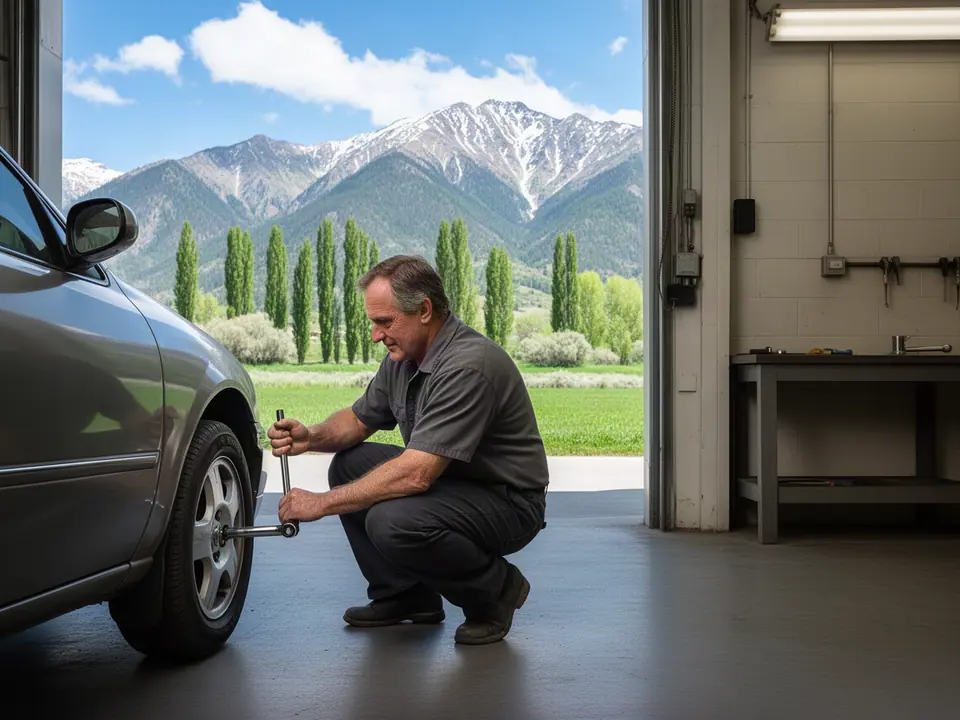
Ironport Capital Group, a small-business funding service in Logan, Utah, helps Cache County auto repair and maintenance shops find equipment financing for lifts and diagnostic tools, inventory financing for parts, and working capital for fleet and warranty receivables. The county had 87 repair shops with employees in 2023 (CBP) and 116 without payroll in 2024 (NES).
| Auto repair and maintenance, Cache County | 87 employer establishments in 2023 (CBP, NAICS 8111) |
|---|---|
| Employees | 590 (CBP 2023) |
| Cache County share under five staff | 48.3% (CBP 2023) |
| No-payroll repair businesses (NES 2024) | 116 in 2024 (Nonemployer Statistics, NAICS 2022 8111) |
How cash moves through a Cache Valley, UT repair shop
Retail customers pay at pickup, usually by card. Fleet accounts, dealers sending overflow work, and warranty or insurance jobs pay on terms, sometimes 30 days or more. Parts are bought from suppliers on account or at the counter, often before the job is finished. Technicians are paid every week or two whether the bay was full or not.
Working capital for an auto repair shop covers the gap left by fleet and warranty receivables; equipment financing covers the bays.
Automotive lift financing
Two-post and four-post lifts, alignment lifts and scissor lifts are big-ticket items with long lives, which suits equipment financing. Two-post car lift financing is usually straightforward because lifts last many years and have a resale market; installation, concrete work and electrical are soft costs to ask about.
A labeled example: two new lifts
Illustration only, with invented figures. A shop adds two two-post lifts at $5,800 each plus $2,400 in installation, $14,000 total, with no down payment. Financing over 36 months at a rate of 10 percent a year gives a payment of about $452 a month and total interest of about $2,260. If the new bays add a few billable hours a day, the payment is covered by the first days of each month. The equipment payment calculator runs your figures.
Auto repair equipment financing options beyond lifts
Scan tools and diagnostic platforms, alignment machines, tire changers and balancers, ADAS calibration equipment, A/C recovery machines and air compressors are all common auto shop equipment financing purposes. Diagnostic tools age quickly as vehicles change, so shorter terms or leases can make sense for them. See equipment financing for the structures.
Parts inventory
Shops that stock common parts, tires or fluids carry inventory that turns over fast. Inventory financing or a line of credit can fund larger stock orders, such as tire stocking ahead of a season or a bulk fluid purchase. Keep a stock list with costs; partners value inventory they can see.
How much does it cost to buy a mechanic shop in Logan, UT?
There is no local figure for it, and this site does not estimate one. The price depends on the equipment, the lease, the customer base and the shop's earnings. A mechanic shop business loan for a purchase is reviewed on the seller's records and your experience. Ask the seller for three years of returns, a list of equipment with ages, and the lease. A term loan is the common structure.
Adding a bay: space, power and permits
A new bay is more than a lift. It may need a larger space, a reinforced floor for the lift anchors, extra electrical capacity, compressed air lines and ventilation. If the shop leases its building, the landlord's consent and who pays for improvements come first. Some of this work may need permits; the Cache County and Logan, UT permits guide lists what to confirm.
Budget the whole bay: the lift, the installation, the electrical and air work, any permit and inspection time, and the technician who will work it. Equipment financing covers the lift and tools; a term loan suits the space itself if the work is substantial.
Cache County, UT repair shops: what CBP and NES count
County Business Patterns counted 87 auto repair and maintenance establishments with employees in Cache County in 2023 (NAICS 8111), with 590 employees and about $26.4 million in payroll. just under half, 48.3%, ran with fewer than five people. ZIP 84321 held 31 (ZBP 2023).
Nonemployer Statistics counted 116 repair and maintenance businesses with no paid staff in 2024 (NAICS 2022 code 8111). Those two Census programs measure different groups, so the counts stay apart. The county also had 21 automobile dealers with employees (CBP 2023). County data is on the Logan, UT business page.
Working from the same CBP figures, Cache County's 87 repair and maintenance establishments averaged 6.8 employees and about $44,700 of payroll per employee in 2023, by our arithmetic. 31 of them, about 36%, had a ZIP 84321 address (ZBP 2023), so most of the county's shops sit outside the Logan ZIP. Dividing Nonemployer Statistics receipts by its business count gives about $52,400 per business in 2024 (our arithmetic), a separate program from the employer counts.
Working capital for an auto repair shop between parts invoices and fleet checks
A repair shop pays for parts on its supplier account terms, pays technicians every week or two, and collects from retail customers at pickup. Fleet and commercial accounts are the exception: they are often billed monthly and paid on the customer's schedule. A shop that adds two or three fleet accounts can find its receivables growing faster than its bank balance.
Illustration only, with invented figures: a shop bills a fleet customer $6,500 a month and is paid 45 days after each invoice. Parts on those jobs, about $2,600 a month, are due to the supplier in 30 days, and the labor has been paid weekly. By the time the first fleet check arrives, the shop has fronted roughly the whole first month's job cost. Working capital for an auto repair shop, or a modest line of credit, is sized to that fronted amount, not to annual sales.
Comebacks and warranty work add another cost with no new invoice behind it. Track them by month; a partner reading your statements will see the dips and may ask what caused them.
What partners commonly review for small business loans for an auto repair shop
- Business bank statements alongside card-processor reports
- A list of fleet and warranty accounts with their terms
- Equipment quotes with installation broken out
- Stock list, for inventory requests
- The lease and any existing equipment payments
Partners do not publish approval criteria for repair shops; steady card income and well-paying fleet accounts help.